Gentle by design.
Fragile glassware and everyday ceramics call for careful grip, controlled movement, and a clear way to pause.
A CONCEPT FOR THE NEXT KITCHEN CHORE
A dishwasher cleans what you load. What if the kitchen could take care of the step before that, too?
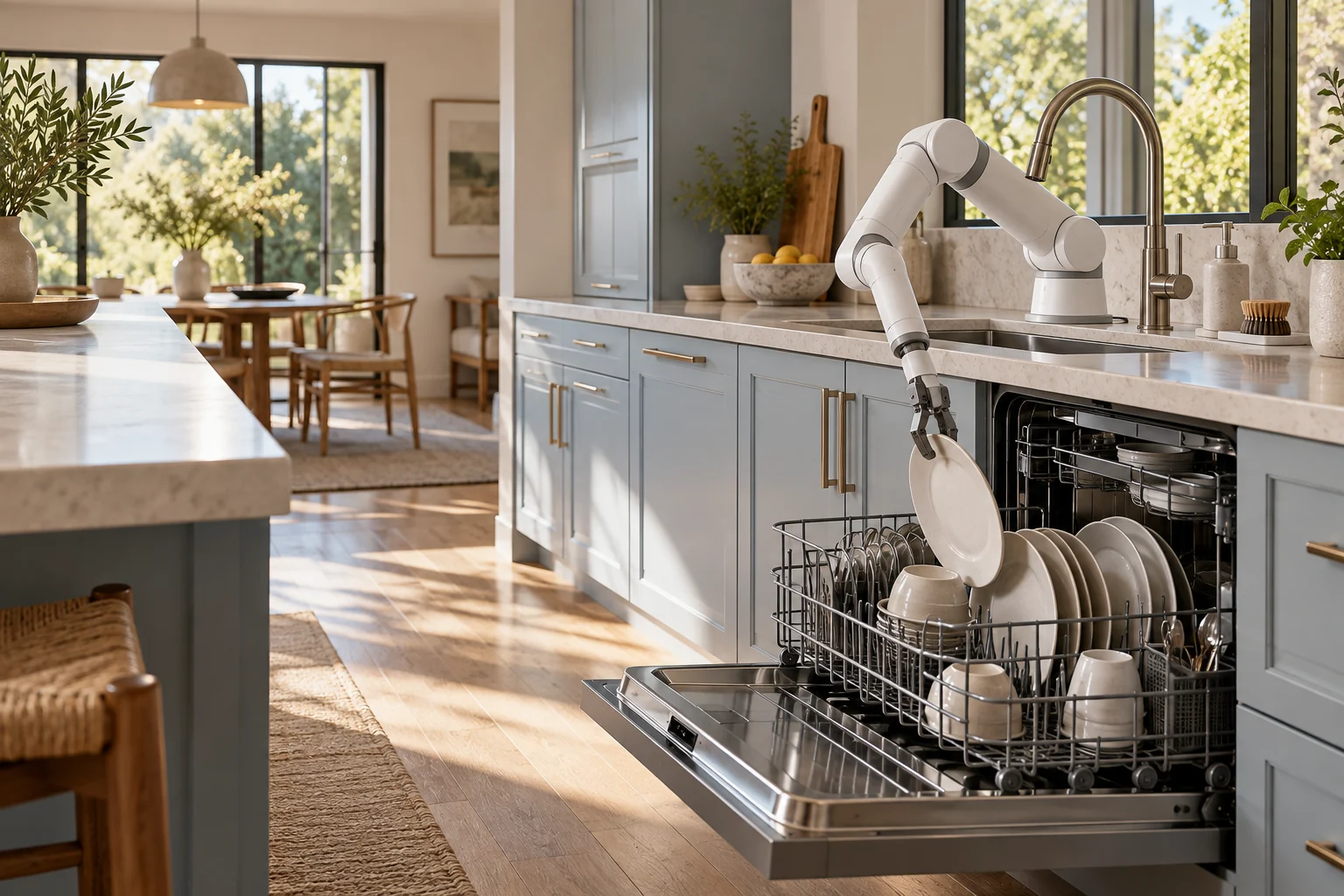 CONCEPT VISUALIZATION · NOT A SHIPPING PRODUCT
01 / THE VISION
Dishwashers solved the washing. We still gather the plates, sort the cutlery, scrape the leftovers, find space on the racks, and put everything away later. A true dishwashing robot would address the whole routine—not simply add another button to an appliance.
The goal: more time around the table, less time clearing it.
02 / THE CONCEPT
Imagine a compact, kitchen-integrated system that recognizes everyday tableware, handles it gently, and works with a conventional wash cycle. It would have to navigate the unpredictable mix left after a real meal: mugs, plates, pans, crumbs, and the occasional delicate glass.
This is an exploration of that idea and the design decisions needed to make it useful. The images and cycle are illustrative.
Explore the cycle03 / HOW IT COULD WORK
Four moments in an imagined hands-free dish care cycle. Select a step to see what the robot would need to do.
Identify dishes, utensils, and leftover food in a changing kitchen scene. Understand what can be handled and what needs a person’s help.
PERCEPTION + UNCERTAINTY04 / DESIGN PRINCIPLES
The promise only matters if it works in the kitchen people actually have.
Fragile glassware and everyday ceramics call for careful grip, controlled movement, and a clear way to pause.
A useful design should respect counter space, existing appliances, water, power, and the people moving around it.
People should know what the robot is doing, what it could not do, and when it needs a hand.
05 / THE REAL QUESTIONS
Robotic dish care is a compelling idea. The interesting work lies in making it reliable, safe, and genuinely convenient.
How can one system handle the variety of dishes in a real home?
What should happen when a dish is too delicate, greasy, or awkward to pick up?
Can the entire routine save enough effort to justify the space and complexity?
FROM THE JOURNAL
If people cannot tell what the machine is doing, they will not let it near the good glasses.
Read the articlePlates, a saucepan, a jam jar, a phone that should not get wet. Perception is the first and hardest problem.
Read the articleWashing dishes is solved. Gathering them is not. A look at the small, messy gap a dishwashing robot would have to close.
Read the article